My boss woke me up while I was sleeping in my car in a customer’s parking lot. I don’t remember what I said. Something automatic, something that sounded like an explanation. What I remember is the look on his face — not angry, exactly. More like a man watching something happen that he couldn’t stop. I straightened up, started the car, and drove to the next call like nothing had happened. Because that was the skill I had refined above all others by then: the ability to keep moving while being completely absent from my life.
That parking lot wasn’t the bottom. It was a Tuesday. It would be another ten years before I found a solution I could live with.
And the funny part is…there is still a version of me that exists somewhere in the past, sitting in a car in a parking lot, engine running, not going anywhere.
I tell that story because most people reading this have their own version of that parking lot. The details are different. The feeling is the same. A life lived from the outside in — managed and performed — mostly numb, until something gave way.
For me, that giving way was the beginning of everything.
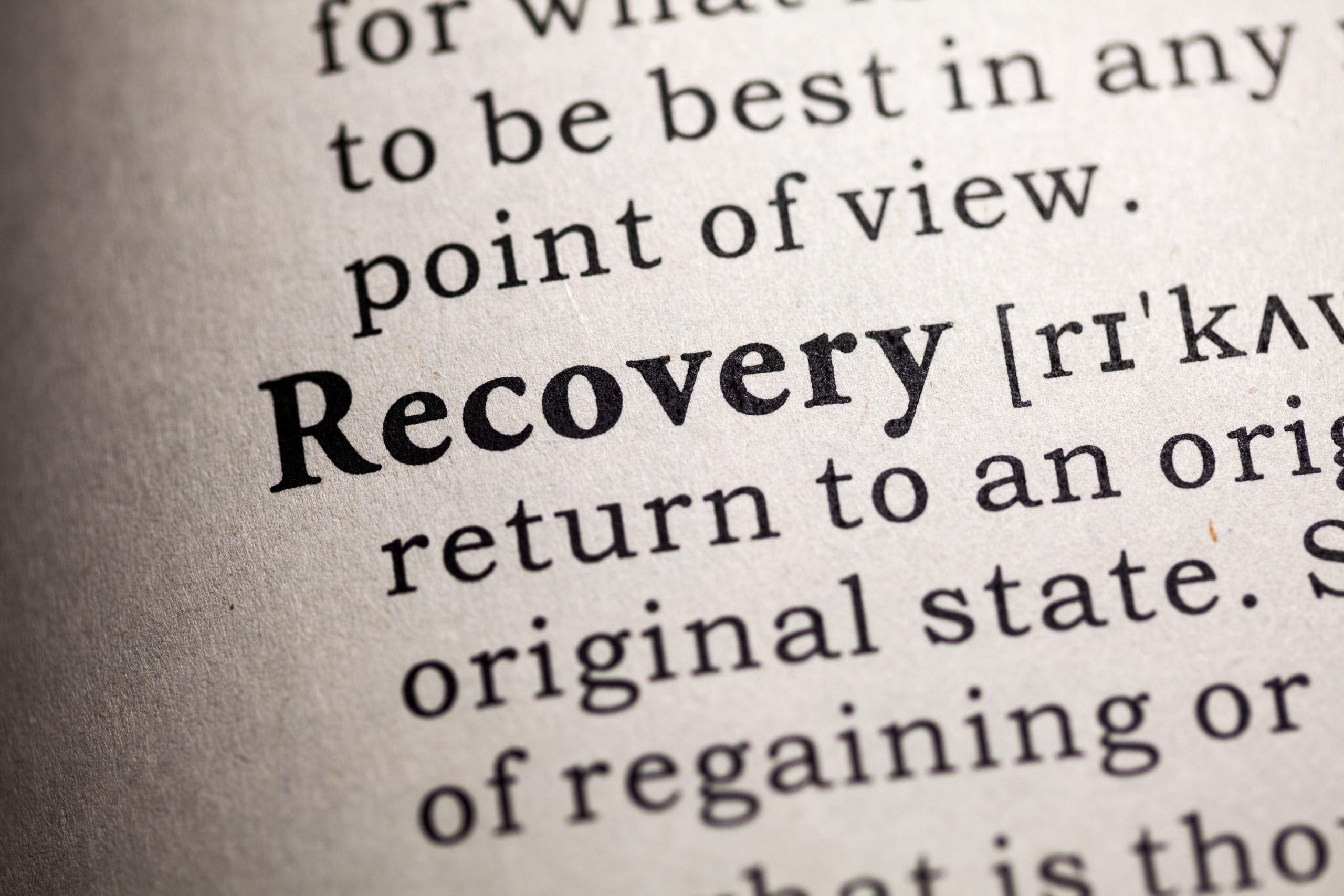
We use the word recovery because it’s the word we have. It’s not a bad word. But if we’re not careful, it can shrink the thing it’s trying to describe. Recovery suggests we’re retrieving something lost, returning to a prior condition, getting back to baseline. And there’s truth in that. But it isn’t the whole truth.
Because some of us — maybe most of us — don’t want to go back to baseline. Baseline is what we were medicating.
What happened when I got into recovery wasn’t a return. It was a foundation. Not to some achieved state of spiritual excellence, but to the beginning of something I hadn’t known was possible: the experience of being present in my life. I want to tell you; I was a pastor for much of this time and did not know how asleep I was. Which is either; very ironic or very sad, but probably both.
Anthony de Mello, the Jesuit priest and spiritual director who could be pretty blunt about human self-deception, used to say that most people are asleep. He says we’re born asleep; we grow up asleep; we get married asleep; we live all of our life asleep. Not literally — but in the sense that we move through our days on autopilot, reacting from old patterns, mistaking the noise in our heads for reality, never quite inhabiting the moment we’re actually in. He wasn’t talking about people living in addiction specifically. He was talking about everyone. But those of us who have lived inside the particular unconsciousness of active addiction know what he means from the inside. We didn’t just sleepwalk. We ran.
Here’s what I have come to believe, and what this whole project is about: getting clean is the doorway. What’s on the other side of the doorway is the life.
The recovery I found gave me a framework for walking through that door. I am grateful for a spiritual form of recovery in a way that I can’t quite put into words — recovery was given to me when I had nothing else, and it worked. But recovery in itself was never meant to be the destination. The founders of that tradition knew this. They spoke of a spiritual awakening as the goal, not simply abstinence. They pointed toward something interior, something alive, something that abstinence alone cannot produce.
That interior something is what draws me to the great contemplative traditions. Not because I’ve left the recovery community — I haven’t. But because the mystics, across every tradition, seem to be describing the same territory that recovery points toward, using a different vocabulary. The Zen teacher and the Desert Father and the Stoic philosopher and the person with thirty years aren’t saying identical things. But they are, I’ve come to believe, describing the same country from different entry points.
The stoic emperor Marcus Aurelius kept returning to a single practice: look at what’s actually in front of you. Not what you fear, not what you resent, not what you wish was different. What is? There’s something in that practice that feels immediately recognizable to anyone in recovery. We call it acceptance. The Stoics called it amor fati — love of what is. The Buddhists call it equanimity. Whatever we call it, it is the antidote to the thing that was killing us.
I am not a teacher. I want to say that plainly.
What I am is a fellow traveler who has been walking long enough to have a few things worth sharing from the road. Some of what I’ve found has surprised me. Some of it has undone me in the best possible way. Some of it I’m still working out.
This blog — and the conversations it’s meant to start — is for people who are ready to move beyond survival. Who have done the initial work, or are doing it, and are beginning to sense that there’s more. More depth. More aliveness. More of what can only be called meaning, even if that word still feels a little slippery.
We’re not going to talk about spiritual life as a reward for staying clean. We’re going to talk about it as the reason to stay clean — and more than that, as the texture of the life that becomes possible.
We’ll draw from the 12-Steps because so many recovery programs use them. We’ll also draw from the mystics. From the Christian contemplative tradition and from Buddhism and Taoism and Stoicism — because truth is always showing up in unexpected places, and we need all the light we can get.
We’ll talk about silence and about shadows. About the self we built to survive and the self that was there all along. About what it means to actually inhabit your own life.
And we’ll do it, I hope, as people who are honest about not having arrived. Because that’s the only kind of spiritual conversation worth having.
I drove out of that parking lot and kept pretending for a while longer. The pretending was getting heavier. The distance between who I was performing and who I actually was had become impossible to keep crossing alone.
Recovery didn’t close that distance overnight. But it gave me enough stillness to finally see how far apart they’d gotten. And somewhere along the way — I couldn’t tell you exactly when — I had a morning where I sat in silence without dreading my own company. Nothing dramatic happened. No vision, no voice, no moment I could point to. Just a quiet that felt, for the first time, like it belonged to me.
That’s where this whole conversation starts. Not at the bottom. Not at the breakthrough. Right there, in the ordinary silence.
What was the moment you first sensed that recovery might be pointing toward something more than just staying sober?